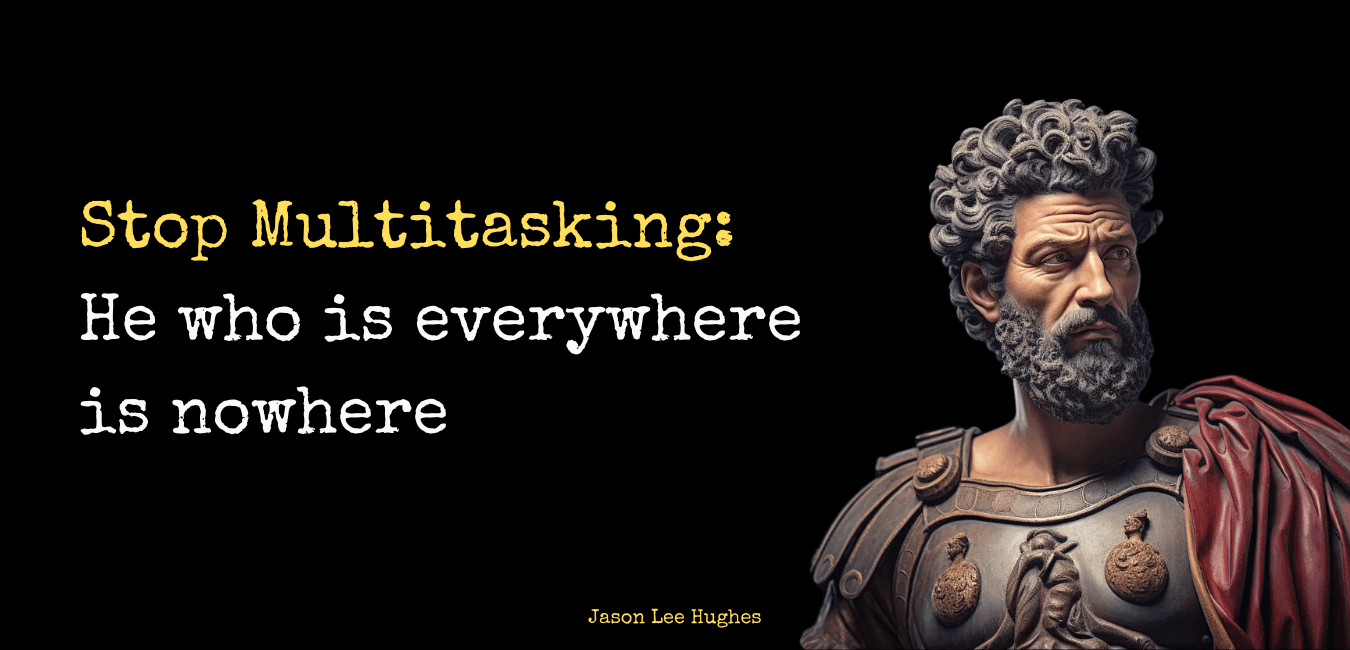
Have you ever found yourself focusing on too many things at once? If so, you are not alone. I discussed this topic in my recent book, Get it Scheduled.
Only about 2 percent of the world’s population can effectively multitask, and it’s safe to say you are not one of those people. When we multitask, we take shortcuts because we’re thinking about other things that do not involve what we’re working on at that moment. In his moral letters to his friend Lucilius Junior, Seneca wrote:
“He who is everywhere is nowhere.”
– Seneca
It is impossible to focus on more than one thing at a time.

This quote resonated with me when I first read it. I have it tattooed on my left forearm as a daily reminder. Whenever I am feeling off track, I look down and ask myself these questions:
- Am I focusing on too many things?
- Is my mind in the past or the present?
- Am I ‘thinking’ about too many things?
Multitasking is an internal and external issue. In other words, you can’t be at the office while thinking about what’s happening at home. Conversely, you shouldn’t be at home while thinking about what is happening at the office. Are both places important? Absolutely. But your mind cannot operate in both areas simultaneously.
Am I focusing on too many things?
Are you working on a critical Excel document while answering emails at the same time? Even if you’re great at using Excel, the odds of making a mistake will increase if you bounce back and forth between writing an Excel formula and responding to an email, especially since they’re two separate topics. Just because you can respond to the email doesn’t mean you must respond immediately. Schedule a time for that so you can focus on the current task.
Is my mind in the past or the present?
Consider this: you can’t grab today’s opportunities if you are still holding yesterday’s adversity. Is your past important? Yes, because you use it to learn from good and bad experiences. However, you can’t stay there. Once time is gone, you never get it back. In his private notes, Meditations, Marcus Aurelius wrote, “Time is like a river made up the events which happen, and a violent stream; for as soon as a thing has been seen, it is carried away, and another comes in its place, and this will be carried away too.”
Am I ‘thinking’ about too many things?
A few months ago, I listened to a powerful podcast by Dr. Phil (Phil in the Blanks), where he talked about multitasking. He framed it this way: OK, Doc, I listened to you. I turned off the stereo and television, got the kids out of the room, and stopped multitasking. No, you didn’t. You stopped external distractions, but you didn’t unclutter your mind. You kept thinking about five different things at one time.
For additional information about this topic, check out my latest book, Get it Scheduled. It can be found on Amazon and will be available on Kindle soon.
Stoic Philosophers
Marcus Aurelius was a Roman emperor from AD 161 to 180 and a Stoic philosopher. He was the last of the rulers known as the Five Good Emporers and the last emperor of the Pax Romana, an age of relative peace and stability for the Roman Empire.

Meditations
Author – Marcus Aurelius and Gregory Hays (Translator)
Pages 256
Seneca was a Roman Stoic philosopher, statesman, dramatist, and satirist from the post-Augustan age of Latin literature. His lasting contribution to philosophy has been to the school of Stoicism.
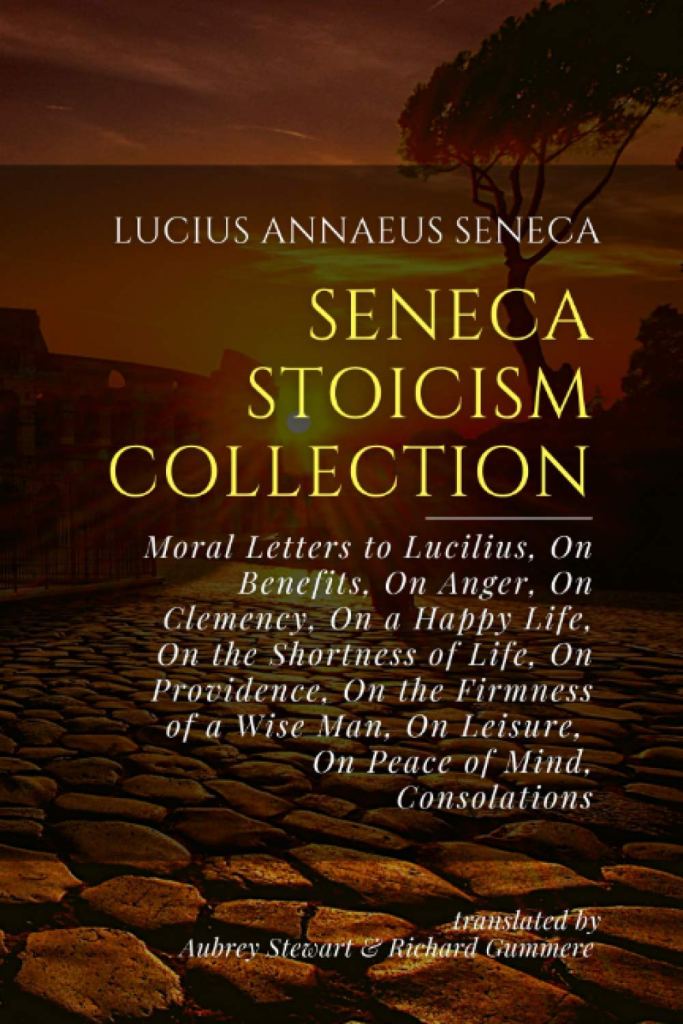
Seneca Stoicism Collection
Author – Lucius Annaeus Seneca
Pages 648
Discover more from Jason Lee Hughes
Subscribe to get the latest posts sent to your email.

 Jason Lee Hughes
This is a constant challenge of mine, especially in the age of social media and constant alerts. I love your exploration of Stoicism, as I’m very partial to this philosophy as well. Thanks for sharing!
LikeLiked by 1 person
Thanks for the feedback, Stuart. Have a great week.
LikeLike